






Posted By: Dr. (Prof.) Kunal Bahrani on 14 Aug 2026
Few experiences are as alarming as suddenly losing consciousness — whether it happens to you or someone you love. One of the most common diagnostic challenges in neurology is determining whether an episode of loss of consciousness was a simple fainting spell (medically termed syncope) or an epileptic seizure. The two can look remarkably similar to bystanders, yet they have entirely different causes, risks, and treatments.
Dr. (Prof.) Kunal Bahrani, a leading neurologist in Faridabad, Delhi NCR, frequently evaluates patients referred for “blackout spells” to determine the true underlying cause — a distinction that is critical for appropriate management.
What Is Syncope (Fainting)?
Syncope is a temporary loss of consciousness caused by a sudden drop in blood flow to the brain. It is extremely common — up to 40% of people experience at least one fainting episode in their lifetime. The most common type, called vasovagal syncope, occurs when the nervous system overreacts to triggers such as standing for long periods, emotional stress, pain, the sight of blood, or rapid changes in posture.
During a faint, blood pressure drops suddenly, blood flow to the brain decreases temporarily, and the person loses consciousness for a brief period — usually seconds to a couple of minutes — before recovering fully and rapidly.
What Is a Seizure?
A seizure, as discussed in our related article on causes of seizures in adults, results from abnormal electrical activity within the brain itself, rather than a drop in blood flow. Seizures can cause loss of consciousness, but the underlying mechanism, associated features, and recovery pattern are quite different from fainting.
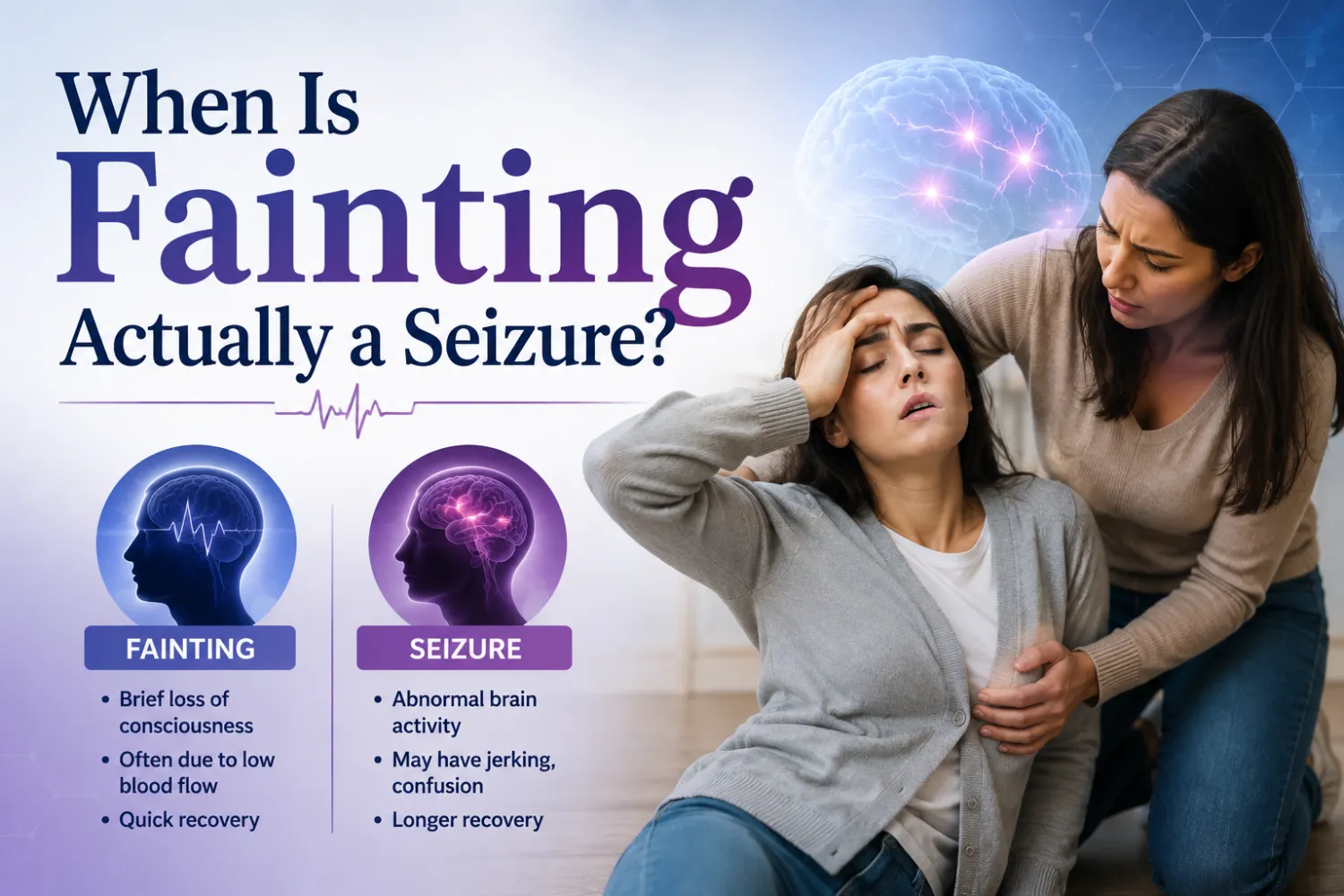
Key Differences Between Fainting and Seizures
Distinguishing between the two relies heavily on details surrounding the episode — triggers, warning signs, the event itself, and the recovery period.
- Triggers and Circumstances
- Fainting: Commonly triggered by prolonged standing, sudden standing from a lying or sitting position, emotional stress, pain, heat, dehydration, or seeing blood. Often occurs in predictable situations.
- Seizure: Can occur without any clear trigger, regardless of position (including while sitting or lying down), and even during sleep.
- Warning Signs Before the Event
- Fainting: Often preceded by a clear prodrome — dizziness, lightheadedness, visual graying or “tunnel vision,” nausea, sweating, and a feeling of warmth lasting 10–30 seconds before losing consciousness.
- Seizure: May have an aura (a strange smell, taste, or feeling) lasting only seconds, or may occur with absolutely no warning at all.
- Appearance During the Episode
- Fainting: The person typically becomes pale, sweaty, and limp, sometimes with brief jerking movements (convulsive syncope) that can be mistaken for a seizure but are usually brief and irregular.
- Seizure: Typically involves more sustained, rhythmic jerking movements of the limbs, stiffening of the body, and the person’s color may become bluish (cyanotic) due to breathing changes during the seizure.
- Tongue Biting and Incontinence
- Fainting: Rarely causes tongue biting; incontinence is uncommon.
- Seizure: Biting the side of the tongue and loss of bladder control are both more commonly associated with generalized seizures.
- Duration of Unconsciousness
- Fainting: Usually very brief — typically less than 20 seconds.
- Seizure: Often lasts 1–3 minutes for the convulsive phase.
- Recovery Period
- Fainting: Recovery is usually rapid — the person regains full alertness within a minute or two, although they may feel weak or nauseated briefly.
- Seizure: Often followed by a “postictal” period of confusion, disorientation, deep sleepiness, or headache lasting minutes to hours. The person may not remember the event at all.
- Injuries
- Fainting: Injuries can occur from falling but are usually related to the fall itself.
- Seizure: Tongue biting, shoulder dislocation (in some types), and injuries from prolonged convulsive movements are more characteristic.
Other Conditions That Mimic Seizures
Besides simple fainting, several other conditions can be mistaken for seizures, including:
- Cardiac arrhythmias: Abnormal heart rhythms can cause sudden loss of consciousness (cardiac syncope) and can sometimes be life-threatening if not identified.
- Panic attacks: Can cause altered awareness, trembling, and a feeling of detachment that may resemble certain seizure types.
- Transient ischemic attacks (TIAs): Brief neurological symptoms from temporarily reduced blood flow to the brain.
- Psychogenic non-epileptic seizures (PNES): Episodes that resemble epileptic seizures but are not caused by abnormal brain electrical activity; these have a psychological basis and require very different management.
- Low blood sugar (hypoglycemia): Can cause confusion, sweating, and loss of consciousness, particularly in people with diabetes.
Why Getting the Right Diagnosis Matters
Misdiagnosing a seizure as a simple faint — or vice versa — can have serious consequences. A person with undiagnosed epilepsy who is not started on appropriate medication remains at risk of further seizures, which can be dangerous while driving, swimming, or working at heights. Conversely, unnecessarily diagnosing and treating someone for epilepsy when they actually have a cardiac cause of fainting means the true, potentially life-threatening cardiac condition goes unaddressed.
How Neurologists Make the Diagnosis
Dr. Bahrani’s evaluation of “blackout” episodes typically includes:
- Detailed history from the patient and, crucially, any witnesses who observed the event
- Description of triggers, warning signs, the episode itself, and recovery
- Physical and neurological examination
- ECG (electrocardiogram) to screen for cardiac causes
- EEG (electroencephalogram) if a seizure is suspected
- Brain MRI in select cases
- Tilt-table testing, in some cases, to assess for vasovagal syncope
- Cardiac monitoring (Holter monitor) if an arrhythmia is suspected
A witness account is often the single most valuable piece of information in making an accurate diagnosis. If possible, recording a video of the event on a smartphone can be enormously helpful for the evaluating neurologist.
Conclusion
Fainting and seizures can look deceptively similar but stem from entirely different mechanisms requiring entirely different management approaches. If you or a loved one has experienced an unexplained loss of consciousness, do not assume it was “just a faint.” A thorough neurological evaluation can provide an accurate diagnosis and ensure you receive the right treatment. For expert evaluation of blackout spells in Faridabad and Delhi NCR, consult Dr. (Prof.) Kunal Bahrani.
📅 Book Your Appointment with Dr. (Prof.) Kunal Bahrani
Consult Dr. (Prof.) Kunal Bahrani – Leading Neurologist in Faridabad, Delhi NCR
Yatharth Super Speciality Hospital, Sector 20, Faridabad
Plot No 9, Sector-20, Krishna Nagar, New Industrial Township, Faridabad, Haryana 121007
Timing: Mon–Sat | 12:00 PM – 5:00 PM
Phone: +91 8527841220
Yatharth Super Speciality Hospital, Sector 88, Faridabad
RPS City, Sector 88, Faridabad, Haryana 121014
Timing: Mon–Sat | 10:00 AM – 12:00 PM
Phone: +91 8130048652
Mediclub Clinic
House No. 857, Ground Floor, Sector 21C, Faridabad, Haryana 121001
Timing: Mon–Sat | 5:30 PM – 7:30 PM
Phone: +91 8527841220
Email: drkunalbahrani@gmail.com