





Posted By: Dr. (Prof.) Kunal Bahrani on 05 Jun 2026
Post-Traumatic Stress Disorder (PTSD) is one of the most debilitating and misunderstood neuropsychiatric conditions. In India, PTSD affects an estimated 3–4% of the population, with significantly higher rates among military veterans, survivors of natural disasters, victims of sexual violence, and individuals with histories of childhood abuse. Despite the enormity of this burden, PTSD remains severely undertreated — a consequence of stigma, limited access to specialist care, and the inadequacy of conventional treatments for many sufferers.
Standard treatments for PTSD — selective serotonin reuptake inhibitors (SSRIs) and trauma-focused psychotherapy — help many patients but leave a substantial minority with persistent, treatment-resistant symptoms. For these individuals, Repetitive Transcranial Magnetic Stimulation (rTMS) offers a neurobiologically targeted intervention that addresses the specific brain circuit dysfunction underlying PTSD.
The Neuroscience of PTSD: A Brain Under Siege
PTSD is fundamentally a disorder of fear memory consolidation and extinction. Traumatic experiences create deeply encoded fear memories that cannot be adequately suppressed by the prefrontal cortex’s normal inhibitory control. The result is a chronically hyperactivated amygdala — the brain’s threat-detection system — combined with impaired prefrontal and hippocampal regulation.
Neuroimaging studies consistently reveal three key abnormalities in PTSD: hyperactivity of the right amygdala and insula (driving hyperarousal, flashbacks, and emotional reactivity), hypoactivity of the medial prefrontal cortex (impairing fear extinction and emotional regulation), and dysregulation of the right DLPFC (contributing to cognitive avoidance and impaired executive function).
How rTMS Targets the PTSD Brain
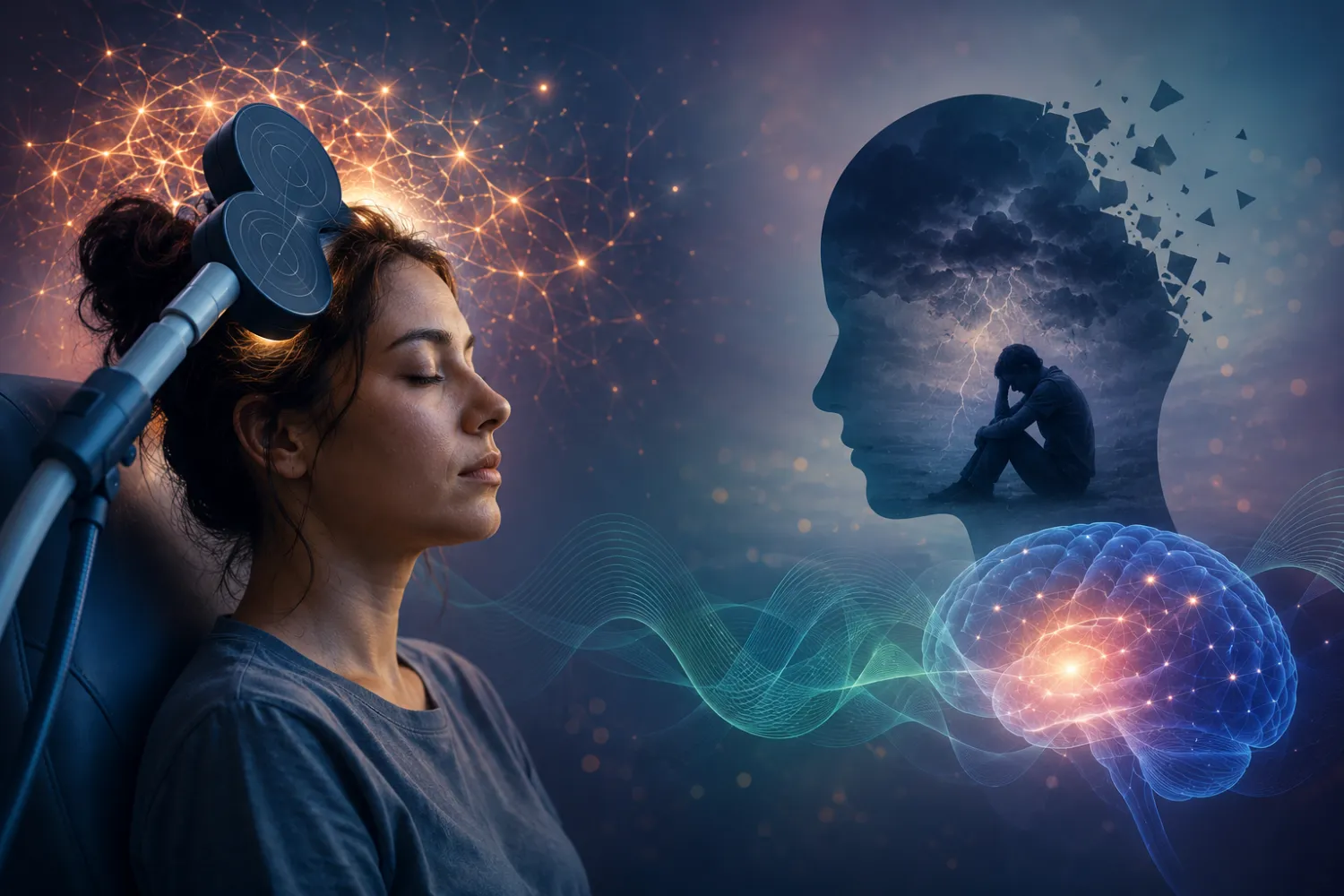
rTMS protocols for PTSD are designed to reverse these neurobiological imbalances. The most evidence-supported approach involves applying inhibitory, low-frequency (1 Hz) rTMS to the right DLPFC, reducing its excessive excitability and, through circuit-level effects, diminishing amygdala hyperactivity and insula hyperarousal. Concurrently, excitatory high-frequency rTMS to the left DLPFC enhances prefrontal inhibitory control over the amygdala, gradually restoring the brain’s capacity to regulate fear responses.
Clinical trials of rTMS in PTSD have demonstrated significant reductions in PTSD severity scores (PCL-5, CAPS), improvements in hyperarousal, avoidance, and re-experiencing symptoms, and reduction in comorbid depression and anxiety. Effect sizes are moderate to large, and response rates of 50–70% have been reported in treatment-resistant PTSD populations.
Integrating rTMS with Trauma-Focused Therapies
At our rTMS treatment centre in Faridabad, rTMS is never deployed in isolation for PTSD — it is integrated within a carefully coordinated trauma-focused care plan:
- EMDR (Eye Movement Desensitisation and Reprocessing): EMDR is one of the most effective trauma-focused psychotherapies available. rTMS, by reducing amygdala hyperreactivity, may lower the emotional activation threshold during EMDR sessions, allowing patients to process traumatic material with less distress and avoidance.
- Prolonged Exposure therapy: PE involves systematic, graduated exposure to trauma memories and triggers. rTMS-enhanced prefrontal regulation supports the fear extinction processes that underpin PE’s therapeutic mechanism.
- SSRIs: For patients with prominent depression and anxiety comorbidities, appropriately selected SSRIs are continued alongside rTMS, with the combination demonstrating superior outcomes to either treatment alone.
- Trauma-informed psychological support: Individual therapy providing psychoeducation, stabilisation techniques, and processing support is coordinated with the rTMS course.
Military Veterans and PTSD: A Special Population
Military veterans represent a population with particularly high rates of treatment-resistant PTSD, often complicated by traumatic brain injury, chronic pain, and comorbid substance use. rTMS has demonstrated particular promise in veteran populations, with several large trials showing significant symptom reduction in combat-related PTSD. The non-pharmacological nature of rTMS is particularly appealing for veterans wary of psychiatric medication.
Safety and the Non-Sedative Advantage
One of the most clinically significant advantages of rTMS for PTSD is what it does not do. Unlike benzodiazepines — still widely prescribed for PTSD-related hyperarousal despite evidence of harm — rTMS produces no sedation, no dependence, no cognitive blunting, and no withdrawal effects. Patients remain fully cognitively intact between sessions and experience no morning sedation or impaired occupational function.
Frequently Asked Questions (FAQs)
How many rTMS sessions are needed for PTSD?
Most PTSD protocols involve 20 to 30 sessions over 4 to 6 weeks. Longer courses are sometimes used for treatment-resistant or complex PTSD.
Can rTMS be used alongside trauma therapy?
Yes, and this combination is strongly recommended. rTMS and trauma-focused psychotherapy (EMDR, prolonged exposure) are most effective when delivered concurrently.
Is rTMS safe for PTSD patients with traumatic brain injury?
rTMS can be safely used in most patients with mild to moderate TBI, with appropriate safety screening. Patients with penetrating head injuries or metallic cranial implants are excluded.
Will rTMS erase my traumatic memories?
No. rTMS does not erase memories. It reduces the emotional reactivity and hyperarousal associated with traumatic memories, making them less intrusive and distressing.
Where can I find an rTMS specialist near me for PTSD in Faridabad?
Prof. (Dr.) Kunal Bahrani is a leading Repetitive Transcranial Magnetic Stimulation doctor in India with expertise in PTSD management. His clinics are located at Yatharth Super Speciality Hospitals in Faridabad, offering rTMS treatment near you.
Book an Appointment with Dr. Kunal Bahrani
India’s leading rTMS specialist | Best rTMS Therapy in Delhi NCR | rTMS Treatment Near You
Yatharth Super Speciality Hospital, Sector 20, Faridabad
Plot No 9, Sector-20, Krishna Nagar, New Industrial Township, Faridabad, Haryana 121007
Timing: Mon-Sat – 10:00 AM to 12:00 PM
Phone: +91 8527841220
Yatharth Super Speciality Hospital, Sector 88, Faridabad
RPS City, Sector 88, Faridabad, Haryana 121014
Timing: Mon-Sat – 12:00 PM to 05:00 PM
Phone: +91 8130048652
Mediclub Clinic
House no 857, Ground Floor, Sector 21C, Faridabad, Haryana 121001
Timing: Mon-Sat – 5:30 PM to 7:30 PM
Phone: +91 8527841220
Email: drkunalbahrani@gmail.com