







Posted By: Dr. (Prof.) Kunal Bahrani on 05 Oct 2026
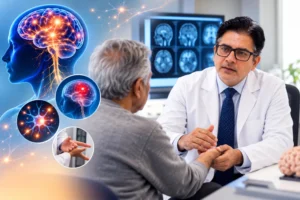
An elderly gentleman from Sainik Colony came in with his daughter a few months ago — not because of any symptom he’d noticed himself, but because she’d started finding it strange that he asked her the same three or four questions every time they spoke on the phone, sometimes within the same conversation. He felt completely fine. She was the one who’d quietly been worried for weeks before finally insisting on a consultation. That gap — between what a patient notices and what family members pick up on — is something I see often with memory-related concerns, and Sainik Colony, with its mix of long-settled families and older residents, is where I encounter this particular pattern fairly regularly.
Sainik Colony has a fairly distinct character within Faridabad — a lot of established households, a sizeable population of senior citizens, alongside younger families who’ve grown up in the area. That combination brings a fairly broad spread of neurological concerns into my practice, from age-related memory changes and tremors to migraine and stress-related headaches in younger residents.
When Should Sainik Colony Residents See a Neurologist?
Some neurological symptoms are dramatic and impossible to ignore. Many others are quiet, gradual, and easy to explain away for months or years. The ones worth getting properly evaluated include:
- Headaches that have become more frequent, more intense, or notably different in character
- Memory lapses that go beyond ordinary forgetfulness — repeating questions, losing track of recent events, or difficulty with familiar tasks
- Tremors, stiffness, or a noticeable change in gait or movement
- Numbness, tingling, or weakness, particularly affecting one side of the body
- Dizziness or vertigo that recurs rather than happening as an isolated incident
- Seizure-like episodes, including brief unresponsiveness or unexplained confusion
- Persistent tingling or burning sensations in the feet or hands
As I tell most patients, the presence of one of these symptoms doesn’t automatically mean something serious — but persistence, a change in pattern, or a family member repeatedly raising a concern are all reasonable triggers for an actual evaluation rather than continued observation at home.
Conditions I See and Treat
My practice covers stroke, migraine and chronic headache disorders, epilepsy, Parkinson’s disease and other movement disorders, dementia and cognitive decline, and neuropathy, along with multiple sclerosis and neuromuscular disorders. Given the demographic mix in Sainik Colony, memory and cognitive concerns in older patients, alongside tremor and movement disorders, come up somewhat more often here than in some of Faridabad’s newer, younger residential sectors — though the full range of neurological conditions is represented across every part of the city.
Why the Distinction Between Normal Ageing and a Neurological Condition Matters
One of the more delicate parts of my practice involves helping families understand the difference between changes that come with normal ageing and changes that indicate a genuine neurological condition. Occasional forgetfulness, slight slowing down, or the odd word mix-up are common and usually not concerning. Progressive memory decline that affects independence, a tremor that steadily worsens, or a change in gait that increases fall risk are different — and telling these apart accurately requires proper neurological training, not just clinical intuition.
I completed my MBBS and MD in General Medicine at BHU, followed by a DM in Neurology from AIIMS, New Delhi, along with international qualifications including MRCP (UK), FRCP (London), FRCP (Glasgow), and FEBN. Over more than 15 years of practice, a substantial part of my clinical work has involved exactly this kind of assessment — separating ordinary ageing from conditions that genuinely need active management. More detail on my training is available on the about page.
What Happens During a Consultation
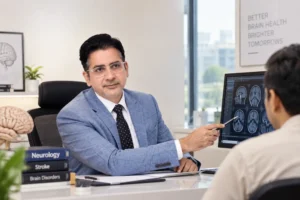
A first visit typically starts with a detailed conversation — about the specific symptom, when it started, how it’s progressed, and what family members have observed, since this last part is often more informative than what the patient reports themselves in cases involving memory or behavioural change. This is followed by a neurological examination assessing memory, reflexes, coordination, and movement. Depending on what emerges, I may recommend further investigations like brain imaging or specific memory assessments, or I may be able to provide a clear explanation and management plan directly from the consultation itself.
When It’s a Medical Emergency, Not a Clinic Visit
Sudden facial drooping, weakness or numbness on one side of the body, sudden difficulty speaking, sudden vision loss, or an abrupt, severe loss of balance are warning signs of stroke and require immediate emergency medical attention. These should never wait for a scheduled neurology appointment — go to the nearest emergency room right away.
Neurologist Near Sainik Colony, Faridabad — Where Can You Consult Dr. Kunal Bahrani?
Residents of Sainik Colony are reasonably placed to reach either the Mediclub Clinic in Sector 21C or Yatharth Super Speciality Hospital in Sector 20, depending on which is more convenient. Current consultation days and timings are listed on the contact page — I’d recommend confirming your slot before visiting, as timings are occasionally updated. You can view current availability and book an appointment here.
Frequently Asked Questions
My elderly parent seems forgetful, but they say it’s normal for their age — should we still get it checked? If family members have noticed a pattern that concerns them, it’s worth a proper evaluation, even if the person themselves feels it’s normal. Family observation is often more reliable than self-assessment in these situations.
Does a neurologist treat tremors in elderly patients? Yes. Tremor evaluation, including distinguishing between essential tremor, Parkinson’s disease, and other causes, is a routine part of neurological practice.
Can a neurologist help with dizziness that happens mostly when standing up? This can have several causes, some related to blood pressure regulation rather than the nervous system directly. A neurological evaluation can help determine whether further cardiovascular assessment is needed alongside neurological care.
Is memory loss always a sign of dementia? No. Memory changes can result from several causes, including vitamin deficiencies, thyroid issues, depression, and other treatable conditions, in addition to neurodegenerative disorders. A proper evaluation is needed to determine the actual cause.
How can Sainik Colony residents book a consultation? You can check current consultation locations and timings and book directly through the appointment page, or get in touch via the contact page.
If you or a family member in Sainik Colony has noticed a change — in memory, movement, or general functioning — that’s persisted for more than a few weeks, it’s worth getting it properly evaluated rather than assuming it’s simply part of getting older. A clear diagnosis, whatever it turns out to be, is almost always more useful than continued uncertainty.