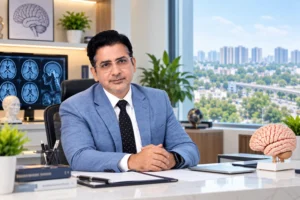








Posted By: Dr. (Prof.) Kunal Bahrani on 25 Aug 2026
Most people don’t wake up knowing what a neurologist actually does. They find out because something felt wrong — a headache that wouldn’t quit, a hand that started shaking, a parent who suddenly couldn’t find the right words mid-sentence. And once a doctor says the word “neurologist,” the questions start piling up fast: what will happen at the appointment, is this serious, what tests will be done, how much will it cost.
This blog pulls together the questions patients in Faridabad most commonly ask about neurologists in general, and about consulting Dr. Kunal Bahrani, Chairman & Group Director of Neurology at Yatharth Super Speciality Hospitals, in particular. It’s organised so you can jump to the section that matches where you are right now — whether you’re still deciding if you even need to see a neurologist, or you already have an appointment booked and want to know what to expect.
Understanding What a Neurologist Does
What exactly is a neurologist, and how is that different from a neurosurgeon?
A neurologist is a physician who diagnoses and treats disorders of the brain, spinal cord, nerves, and muscles — but does so medically, through medication, therapy, and non-surgical procedures. A neurosurgeon treats many of the same organs but operates on them surgically. In practice, the two often work together: a neurologist like Dr. Bahrani will typically be the first point of contact, diagnose the condition, manage it with medical treatment where possible, and refer to a neurosurgeon only if surgery becomes necessary — for instance, in certain brain tumours, severe spinal compression, or specific types of haemorrhagic stroke.
What conditions does a neurologist actually treat?
The range is wider than most people expect. Common conditions include stroke, epilepsy and seizure disorders, migraines and chronic headaches, Parkinson’s disease and other movement disorders, multiple sclerosis, peripheral neuropathy (nerve damage causing numbness or tingling), Bell’s palsy, trigeminal neuralgia, dementia and memory disorders, and sleep disorders such as chronic insomnia. Dr. Bahrani’s practice in Faridabad covers all of these, with particular depth in stroke care, epilepsy management, migraine treatment, and movement disorders.
Is a neurologist different from a psychiatrist?
Yes, though the confusion is common because both deal with the brain. A neurologist focuses on the physical structure and function of the nervous system — things that often show up on scans or nerve tests, like stroke, seizures, or nerve damage. A psychiatrist focuses on mental health conditions such as depression, anxiety, or bipolar disorder, which don’t typically show structural changes on imaging. Some conditions, like severe migraines affecting mood or sleep disorders linked to anxiety, can sit at the overlap, and a neurologist will refer to psychiatry when needed.
When Should You Actually See a Neurologist?
What symptoms mean I should stop waiting and book an appointment?
Certain symptoms deserve a same-day or urgent visit rather than a wait-and-watch approach: sudden weakness or numbness on one side of the body, slurred or garbled speech, sudden severe headache unlike any before, loss of balance or coordination, a seizure (even a first-time one), sudden vision loss, or confusion that comes on quickly. These can be signs of stroke or another acute neurological event, where early treatment directly affects long-term recovery.
What about milder, ongoing symptoms — do those need a neurologist too?
Often, yes, even if they feel less urgent. Recurring headaches that interfere with daily life, tremors that are getting more noticeable, persistent tingling or numbness in the hands or feet, memory lapses that are more frequent than “normal” forgetfulness, chronic insomnia that hasn’t responded to basic sleep hygiene changes, or unexplained fatigue combined with muscle weakness are all reasonable reasons to book a consultation. The general rule Dr. Bahrani applies with patients: if a general physician hasn’t been able to explain or resolve the symptom after a reasonable attempt, it’s time for a specialist opinion.
My headaches are bad, but is it a migraine or something more serious?
Most headaches, even quite painful ones, are not dangerous — tension headaches and migraines account for the vast majority. But certain features change the picture: a headache described as “the worst of my life,” one that starts suddenly and peaks within seconds, headaches that wake you from sleep, or headaches accompanied by fever, stiff neck, vision changes, or weakness need prompt evaluation to rule out more serious causes. A neurologist can usually tell the difference through a detailed history and examination, often without needing extensive testing.
What to Expect at Your First Visit
What actually happens during a first consultation with a neurologist?
The first visit is largely about history-taking. Dr. Bahrani typically starts by asking detailed questions about when symptoms began, how they’ve changed, what makes them better or worse, family medical history, and any medications currently being taken. This is followed by a neurological examination — checking reflexes, muscle strength, coordination, sensation, and sometimes memory or speech, depending on the presenting complaint. Based on this, he’ll either arrive at a working diagnosis directly or recommend specific tests to confirm it.
What should I bring to my first appointment?
It genuinely helps to bring any previous test reports, scans (MRI, CT, or EEG on disc or printout), a list of current medications with dosages, and — if possible — a family member who has witnessed the symptoms, especially for seizures, memory issues, or episodes of confusion, since patients often can’t describe what happened during the event itself. Writing down when symptoms occur and any patterns you’ve noticed beforehand can also save time during the consultation.
What tests might a neurologist order, and are they painful?
Depending on the suspected condition, common tests include an MRI or CT scan of the brain or spine (painless, though MRI involves lying still in a machine for 20–40 minutes), an EEG to record brain electrical activity for suspected seizures (painless, involves scalp electrodes), an EMG/nerve conduction study for suspected nerve or muscle problems (involves small electrical pulses, mildly uncomfortable but brief), and blood tests to rule out metabolic or autoimmune causes. Not every patient needs every test — Dr. Bahrani generally orders only what’s relevant to the specific symptoms rather than a blanket panel.
Will I need to fast or prepare in any special way before tests?
Most neurological tests like MRI and EEG don’t require fasting, though certain blood tests might. Specific instructions — such as reduced sleep before an EEG to help capture seizure activity, or avoiding caffeine before certain tests — will be given at the time of ordering, since requirements vary by test and by individual case.
Questions About Specific Conditions
How is a stroke diagnosed and treated, and does timing really matter that much?
Timing matters enormously. In ischemic stroke (caused by a blocked blood vessel), clot-dissolving treatment (thrombolysis) is generally most effective within a few hours of symptom onset — often described to patients as “time is brain,” since delayed treatment means more brain tissue is lost. Diagnosis typically involves an urgent CT or MRI scan to confirm the type of stroke, since treatment differs sharply between a clot-related stroke and a bleed. Dr. Bahrani has specifically been recognised for his work in acute stroke management and thrombolysis, including for his role as Principal Investigator in stroke care initiatives honoured by the World Stroke Organization.
I had one seizure — does that mean I have epilepsy?
Not necessarily. Epilepsy is generally diagnosed after two or more unprovoked seizures, or one seizure with a high risk of recurrence based on EEG or scan findings. A single seizure can sometimes be triggered by fever, extreme sleep deprivation, alcohol withdrawal, or low blood sugar without indicating epilepsy. A neurologist will typically order an EEG and sometimes an MRI to assess the underlying risk before deciding whether long-term treatment is needed.
Are migraines something I just have to live with, or can they actually be treated effectively?
They can usually be managed far better than most patients expect, especially chronic migraines that occur more than 15 days a month. Treatment options range from lifestyle and trigger management, to preventive medications taken daily, to Botox therapy for chronic migraine — an option Dr. Bahrani offers for patients who haven’t responded well to standard preventive medication. The right approach depends on frequency, severity, and how much migraines are disrupting daily life, so treatment plans are generally built around the individual patient rather than a one-size-fits-all prescription.
What is trigeminal neuralgia, and why is it so hard to diagnose?
Trigeminal neuralgia causes sudden, severe, electric-shock-like facial pain along the branches of the trigeminal nerve, often triggered by everyday actions like chewing, brushing teeth, or even a light breeze on the face. It’s frequently misdiagnosed initially as a dental problem because the pain can be localised to the jaw or teeth. A detailed neurological history and examination, sometimes supported by an MRI to check for nerve compression, is usually how it gets correctly identified and treated.
What is rTMS therapy, and who is it for?
Repetitive Transcranial Magnetic Stimulation (rTMS) is a non-invasive treatment that uses magnetic pulses to stimulate specific areas of the brain. It’s used for certain treatment-resistant conditions and, increasingly, as part of neuro-rehabilitation programmes supporting recovery after stroke. It doesn’t require anaesthesia or admission, and sessions are generally short, making it a practical add-on for patients who haven’t responded fully to standard treatment alone. Dr. Bahrani offers rTMS therapy as part of his practice at Yatharth Hospital.
My elderly parent is becoming forgetful — is that normal ageing or something a neurologist should look at?
Some slowing of memory with age is normal — misplacing keys occasionally or needing a moment to recall a name isn’t unusual. What warrants evaluation is memory loss that interferes with daily functioning: repeating the same questions, getting lost in familiar places, difficulty managing finances or medications they used to handle easily, or noticeable personality changes. These patterns are worth discussing with a neurologist, who can assess whether it’s a treatable cause (like a vitamin deficiency or thyroid issue), a natural age-related change, or something requiring longer-term management.
Practical Questions About Consulting Dr. Kunal Bahrani
Where can I consult Dr. Bahrani, and what are the timings?
Dr. Bahrani consults at Yatharth Super Speciality Hospital, Sector 20, Faridabad, Monday to Saturday from 10:00 AM to 5:00 PM, at the Yatharth campus in Sector 88, Faridabad, and in the evenings at Mediclub Neuro and Gynae Clinic, Sector 21C, Faridabad, from 5:30 PM to 7:30 PM, Monday to Saturday — useful for patients who work through the day.
How much does a consultation cost?
Consultation fees are typically around ₹1,000, though this can vary by location and the nature of the visit (a first consultation versus a follow-up, for example). It’s best to confirm the exact current fee with the hospital or clinic directly when booking, since charges can be revised.
Do I need a referral to see Dr. Bahrani, or can I book directly?
A referral generally isn’t required for a first consultation — patients can book directly. That said, if you’ve already been evaluated by a general physician or another specialist, bringing their notes and any test results along will help make the first neurology consultation more productive.
Is Dr. Bahrani the right choice for a second opinion on an existing diagnosis?
Yes — second opinions are a normal and reasonable part of managing complex neurological conditions, particularly for diagnoses like epilepsy, movement disorders, or planned long-term treatment for chronic migraine, where treatment plans can vary between specialists. Bringing your existing reports, scans, and current treatment plan allows for a focused second opinion rather than starting the diagnostic process over from scratch.
What makes Dr. Bahrani’s qualifications different from a standard neurologist’s in India?
Beyond the standard DM in Neurology from AIIMS, New Delhi, Dr. Bahrani holds the MRCP-SCE Neurology qualification from the UK and the Fellowship of the European Board of Neurology (FEBN), along with Fellowships of the Royal College of Physicians of both Glasgow and London. He’s reportedly the only neurologist in the Faridabad/NCR region holding the MRCP-SCE Neurology and FEBN combination — international benchmarks that go beyond the standard Indian qualification most neurologists practise with.
A Quick Checklist Before Your Visit
- Write down your symptoms, including when they started and what makes them better or worse.
- Bring any previous scans, test reports, or prescriptions, even if they seem unrelated.
- List current medications and dosages, including supplements.
- Bring a family member if the symptoms include seizures, memory issues, or confusion, since they may recall details you can’t.
- Prepare your questions in advance — it’s easy to forget them once the consultation starts.
- Confirm the consultation fee and required documents when booking your appointment.
Still Have a Question?
Neurological symptoms rarely fit neatly into a checklist, and the honest answer to “is this serious” is often “it depends on the details.” If your question isn’t answered here, or your symptoms match anything described under the urgent-visit section above, the most reliable next step is a direct consultation with Dr. Kunal Bahrani at Yatharth Super Speciality Hospital or Mediclub Clinic, Faridabad, rather than trying to self-diagnose from general information online.