






Posted By: Dr. (Prof.) Kunal Bahrani on 07 Aug 2026
Everything a patient or caregiver needs to know before choosing a neurologist in Faridabad — conditions, credentials, treatment options and what an actual visit looks like.
A neurology visit rarely happens on a calm day. It’s usually triggered by something that doesn’t add up — a headache that’s lasted a week, a hand that shakes when it didn’t used to, a parent who repeats the same question three times in an hour. Faridabad has grown fast enough, and its population has aged enough, that these moments are no longer rare. What used to mean a trip to Delhi for a proper neurology opinion is now, for the most part, available inside the city itself.
This guide is written for that exact situation — someone trying to understand what’s actually wrong, what a neurologist does differently from a general physician, and who in Faridabad is equipped to handle it properly. It also introduces the practice of Dr. (Prof.) Kunal Bahrani, Chairman & Group Director of Neurology at Yatharth Hospital, in enough detail that you can judge for yourself whether it fits your situation, rather than just taking a website’s word for it.
Why Neurology Care in Faridabad Matters More Than It Used To
Faridabad has changed shape over the last decade. What was once considered a satellite town to Delhi is now one of Haryana’s larger urban centres, with its own hospital infrastructure, a growing base of corporate professionals with sedentary desk jobs, and an ageing population that’s living long enough to develop the conditions neurology deals with — stroke, Parkinson’s disease, dementia, and peripheral neuropathy chief among them.
For a long time, the default advice for anything neurological in Faridabad was “go to Delhi.” That advice made sense when the city didn’t have neurologists with the right training, or hospitals with round-the-clock imaging and stroke protocols in place. It makes far less sense now. Several hospitals in the city — Yatharth, Fortis, Marengo Asia and the Asian Institute of Medical Sciences among them — have built out dedicated neurology departments with in-house MRI, CT, and EEG facilities, which matters enormously when a diagnosis can’t wait for a referral letter and a drive down the highway.
The gap that remains isn’t access — it’s information. Patients often can’t tell the difference between a general physician who “also sees neuro cases” and an actual DM-qualified neurologist, and that distinction can change outcomes, particularly in time-sensitive situations like stroke.
When Should You Actually See a Neurologist?
Neurology is a broad specialty, and not every symptom needs the same urgency. A useful way to think about it is by how much time you have, rather than by how alarming the symptom feels.
- Sudden one-sided weakness, facial drooping, or slurred speech — this is a medical emergency. Go to the nearest hospital with a stroke unit immediately; do not wait for an appointment. Clot-dissolving treatment for ischemic stroke is most effective within the first few hours of symptom onset.
- A first-time seizure, or a seizure in someone with no prior history — needs prompt neurological evaluation, ideally within days, even if the person appears to recover fully afterward.
- A headache that is sudden, described as “the worst of my life,” or comes with vision changes, vomiting, or neck stiffness — treat as urgent.
- Recurring headaches or migraines that are getting more frequent or more severe over weeks — worth a scheduled consultation rather than an emergency visit.
- A tremor, stiffness, or slowness in movement that has developed gradually over months — points toward a movement disorder evaluation.
- Persistent numbness, tingling, or weakness in the hands or feet — often nerve-related, and benefits from a doctor who regularly interprets nerve conduction studies.
- Noticeable memory lapses, confusion, or personality changes in an older adult — worth investigating rather than dismissing as normal ageing.
- Recurring vertigo or dizziness that affects balance or daily activity — can originate from either the inner ear or the nervous system, and a neurologist can help identify which.
Meet Dr. (Prof.) Kunal Bahrani
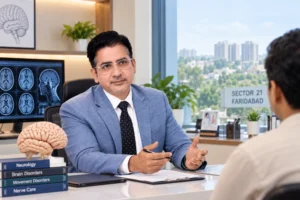
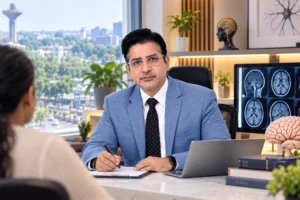
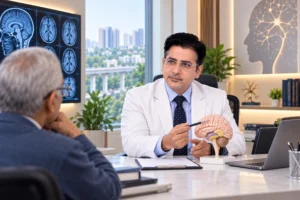
Dr. (Prof.) Kunal Bahrani is the Chairman & Group Director of Neurology at Yatharth Hospital, with consultations across the Sector 20 and Sector 88 branches in Faridabad, and evening consultations at Mediclub Clinic in Sector 21C. He has practiced neurology for more than fifteen years and, over that time, has treated patients across the full range of the specialty — from acute stroke and epilepsy to Parkinson’s disease, dementia, neuropathy, and paediatric neurological conditions such as cerebral palsy.
His academic background follows the standard — and demanding — path for a specialist neurologist in India. He completed his MBBS and MD in General Medicine at the Institute of Medical Sciences, Banaras Hindu University, before going on to earn his DM in Neurology at AIIMS, New Delhi, widely regarded as India’s most competitive institute for super-specialty medical training. Getting a DM seat at AIIMS is itself a filter — it means training under some of the country’s highest patient volumes and most complex neurological cases before ever practising independently.
Beyond his Indian qualifications, Dr. Bahrani holds MRCP (UK), FRCP (London), and FRCP (Glasgow) — fellowships and membership credentials from the Royal Colleges of Physicians that require passing rigorous international examinations — along with FEBN (Fellowship of the European Board of Neurology) and a Fellowship in Interventional Headache Medicine (FIHN), a specialised qualification focused on advanced headache and migraine management. Taken together, this combination of Indian super-specialty training and international board certification is uncommon among neurologists practising in tier-2 cities, and it’s part of why he’s often named when people in Faridabad ask around for a neurology opinion they can trust.
On the patient-facing side, his practice has built up a substantial track record locally — over 900 verified patient reviews with a 4.9 out of 5 rating, and a patient base that includes both routine outpatient consultations and complex referred cases. His YouTube channel and social media presence also feature patient education content, much of it in Hindi, covering topics like the difference between vertigo and dizziness, early stroke symptoms, and dementia versus normal ageing — an effort to make neurology information accessible to people who wouldn’t otherwise seek it out until a crisis forces the issue.
How Neurologists Actually Diagnose Problems
A lot of the anxiety around seeing a neurologist comes from not knowing what the process actually involves — people picture invasive testing or an overnight hospital stay before they’ve even had a first conversation. In practice, diagnosis is usually built in layers, starting with the least invasive step and only escalating when it’s genuinely needed.
Magnetic Resonance Imaging (MRI) remains the most detailed way to look at soft tissue in the brain and spine, useful for spotting structural issues — tumours, signs of stroke, demyelination in conditions like multiple sclerosis, or degeneration linked to dementia. A CT scan is faster and is often the first choice in an emergency, particularly to rule out bleeding in the brain, since it can be done and read within minutes.
An Electroencephalogram (EEG) records the brain’s electrical activity through electrodes placed on the scalp, and is the standard tool for investigating seizures — both confirming epilepsy and, in some cases, identifying which part of the brain a seizure originates from. A Nerve Conduction Study (NCS), sometimes paired with electromyography (EMG), measures how well electrical signals travel along a nerve, which is central to diagnosing conditions like carpal tunnel syndrome, diabetic neuropathy, and other nerve compression or damage issues.
None of these tests are ordered reflexively. A well-run neurology consultation uses the clinical history and physical examination to narrow down what’s actually being investigated first, and orders imaging or electrical studies only where the result would change the treatment plan — which is also why a rushed five-minute consultation is rarely enough to reach a reliable diagnosis in this specialty.
Common Myths About Neurological Conditions
A surprising amount of delay in neurological care comes down to a handful of persistent myths that keep people from seeking help early.
- “Migraines are just bad headaches, they don’t need a specialist.” Migraine is a distinct neurological condition with its own diagnostic criteria and treatment pathways, including preventive options that go well beyond painkillers — chronic migraine that isn’t properly managed can become genuinely disabling.
- “Memory loss in old age is always just aging.” Some decline is expected with age, but a marked drop in memory, judgment, or personality is not automatically “normal,” and a portion of cognitive decline cases have treatable underlying causes.
- “A tremor means Parkinson’s.” Tremor has several possible causes, including essential tremor, thyroid issues, and medication side effects — Parkinson’s disease has a specific pattern that a neurologist can usually distinguish clinically.
- “Seizures always look dramatic.” Some seizures are subtle — a brief lapse in awareness, repetitive small movements, or a moment of unresponsiveness — and get missed or misattributed for months before a proper diagnosis.
- “If a scan comes back normal, there’s nothing wrong.” Many neurological conditions, including epilepsy between seizures and most primary headache disorders, don’t show up on standard imaging — a normal MRI doesn’t rule out a real neurological condition; it rules out certain structural causes.
Conditions Treated: A Closer Look
Neurology as a field covers an unusually wide territory — anything involving the brain, spinal cord, or peripheral nerves falls under it. Here’s a closer look at the major categories Dr. Bahrani’s practice covers, and what each actually involves for a patient.
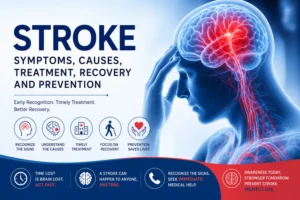
Stroke care is arguably the most time-critical part of neurology. When blood supply to part of the brain is cut off — either by a clot (ischemic stroke) or a bleed (haemorrhagic stroke) — brain cells begin dying within minutes. The standard teaching in stroke medicine is “time is brain”: every minute of delay costs measurable brain tissue.
A hospital equipped for stroke care needs more than a neurologist on staff — it needs in-house CT or MRI available around the clock, a protocol for rapidly distinguishing ischemic from haemorrhagic stroke, and the ability to administer clot-dissolving therapy within the treatment window where it’s effective. Dr. Bahrani’s role at Yatharth Hospital includes managing acute stroke cases as well as the follow-up rehabilitation phase, where therapies like rTMS (repetitive transcranial magnetic stimulation) are increasingly used to support motor and speech recovery after the acute event has passed.
Epilepsy — recurring seizures caused by abnormal electrical activity in the brain — is managed very differently depending on the type and cause. Diagnosis typically involves an EEG to record brain activity and, in many cases, an MRI to rule out structural causes. Treatment is usually built around anti-seizure medication, with the goal of finding the right drug and dose combination that controls seizures with the fewest side effects — a process that often takes patience and follow-up rather than a single prescription.
A single seizure doesn’t automatically mean epilepsy, but it does warrant a proper neurological workup, since the cause could range from a fever in a child to a metabolic imbalance to an underlying structural issue that needs to be identified early.
Migraine and Headache Disorders
Headache is one of the most common reasons people end up in a neurologist’s clinic, and also one of the most frequently mismanaged — largely because most headaches are treated with over-the-counter painkillers until they stop responding. Migraine specifically is a neurological condition, not “just a bad headache,” and it has recognisable patterns: often one-sided, throbbing, worsened by light or movement, and sometimes preceded by visual disturbances known as aura.
Dr. Bahrani’s Fellowship in Interventional Headache Medicine is particularly relevant here — it reflects specialised training beyond general neurology, focused specifically on chronic and treatment-resistant headache disorders, including options like targeted nerve blocks and Botulinum toxin (Botox) injections for chronic migraine, which are used when standard oral medication hasn’t provided adequate relief.
Parkinson’s Disease and Movement Disorders
Parkinson’s disease develops gradually, and that gradual onset is exactly why it’s so often missed in its early stages. A slight tremor in one hand, a change in handwriting size, a reduced arm swing while walking, or a softer voice can all be early signs that get attributed to age or stress for months or years before anyone connects the dots.
Movement disorder evaluation involves a detailed clinical examination — much of Parkinson’s diagnosis is still based on observing how a patient moves, rather than a single definitive lab test — combined with imaging to rule out other causes. Treatment typically combines medication to manage dopamine levels with physiotherapy, and in select cases, procedures like Botulinum toxin injections for specific muscle-related symptoms.
One of the harder conversations in neurology is distinguishing normal age-related forgetfulness from the early stages of dementia. Occasionally misplacing keys is normal; forgetting how to get home from a familiar route, or repeating the same question minutes apart, is not. Vascular dementia and Alzheimer’s disease present differently and require different management approaches, which makes an accurate diagnosis — through cognitive assessment and imaging — more useful than assuming either label based on symptoms alone.
Early diagnosis matters here specifically because some causes of cognitive decline (certain vitamin deficiencies, thyroid issues, or normal-pressure hydrocephalus) are treatable and even reversible if caught in time, which is part of why a proper neurological workup is worth pursuing rather than assuming nothing can be done.
Neuropathy and Nerve Disorders
Nerve-related conditions cover a wide range — diabetic neuropathy (nerve damage from long-term high blood sugar), carpal tunnel syndrome (compression of the median nerve in the wrist), post-herpetic neuralgia (persistent nerve pain following shingles), and trigeminal neuralgia (severe facial nerve pain), among others. What connects them is that they’re diagnosed largely through nerve conduction studies and clinical examination, and management often needs a combination of medication for nerve pain, and in some cases, targeted interventions like nerve blocks.
Diabetic neuropathy in particular is worth flagging separately, given how common type 2 diabetes has become — persistent tingling, numbness, or burning sensations in the feet in someone with diabetes is a signal worth acting on rather than dismissing as circulation trouble.
Vertigo, Balance Disorders and Other Conditions
Vertigo — the sensation that the room is spinning — is frequently confused with general dizziness, but the two have different causes and different treatment paths. Vertigo often originates in the inner ear’s balance mechanism, but it can also stem from the brainstem or cerebellum, which is why a neurological evaluation matters when episodes are frequent, prolonged, or accompanied by other symptoms like double vision or slurred speech.
The practice also manages a range of other conditions that fall under general and paediatric neurology, including cerebral palsy, autism spectrum disorder evaluation, neuromuscular disorders, multiple sclerosis, myasthenia gravis, restless leg syndrome, sciatica and cervical spine-related nerve pain, and central nervous system infections — reflecting the breadth that a comprehensive neurology practice needs to cover, rather than narrowing to one or two high-visibility conditions.
Advanced Therapy: TMS (Transcranial Magnetic Stimulation)
One of the more advanced tools available at the practice is TMS therapy — a non-invasive treatment that uses magnetic pulses to stimulate specific areas of the brain. It’s increasingly used for treatment-resistant depression and OCD, but within neurology specifically, it also has a growing role in stroke rehabilitation, chronic pain management, and select movement disorders, where it’s used to help retrain neural pathways affected by injury or disease.
Unlike medication, TMS doesn’t circulate through the bloodstream, which makes it a useful option for patients who haven’t responded well to drug therapy alone, or who are looking to reduce their dependence on medication. It’s typically delivered as a course of sessions rather than a single treatment, and candidacy is assessed individually based on the underlying condition.
What Sets This Practice Apart
On paper, a lot of neurologists list similar qualifications and treat similar conditions. What tends to actually matter to a patient is less visible on a website — how quickly a diagnosis is reached, how clearly a treatment plan is explained, and whether the doctor is reachable if something changes between visits.
A few things stand out about how this practice is set up. First, the breadth of coverage — from acute stroke management to chronic headache to paediatric neurology — means patients don’t need to figure out which sub-specialist they need before booking; the initial consultation itself helps identify the right path. Second, the availability across three locations (two Yatharth Hospital branches and an evening clinic) gives patients flexibility around work schedules, which matters for a specialty where follow-up visits are often necessary. Third, the practice leans on advanced diagnostics and therapies — nerve conduction studies, EEG, in-house imaging, and TMS — rather than referring patients elsewhere for anything beyond a basic consultation.
None of this replaces doing your own homework before a first visit. It’s worth asking directly whether a doctor handles emergency stroke cases or only scheduled consultations, how many years they’ve practised independently after training, and whether the hospital has in-house imaging — the same questions worth asking of any neurologist, not just this one.
What to Expect at Your First Visit
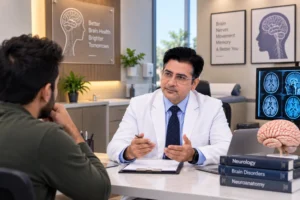
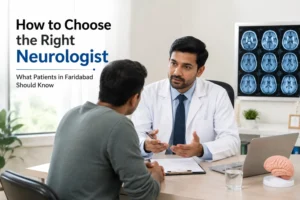
A first neurology consultation usually starts with a detailed history — not just the current symptom, but its timeline, what makes it better or worse, family history, and any medications already being taken. This is followed by a focused neurological examination, checking reflexes, muscle strength, coordination, and sensation, depending on the presenting complaint.
Based on that initial assessment, the doctor may recommend further tests — an MRI or CT scan for structural issues, an EEG for suspected seizure activity, or a nerve conduction study for numbness or weakness. Not every visit requires imaging; a clear clinical picture (like a classic migraine pattern) sometimes doesn’t need one at all, and part of a good neurologist’s job is knowing when a test will actually change management versus when it’s unnecessary.
Patients are generally encouraged to bring any previous test reports, a list of current medications, and — where relevant — a family member who can describe changes the patient themselves might not notice, such as memory lapses or personality shifts.
Neurology, more than many specialties, is often about long-term management rather than a single fix. Chronic conditions like epilepsy, Parkinson’s disease, and migraine typically involve periodic follow-up visits to adjust medication, track progression, and catch complications early — which is part of why continuity with one neurologist, rather than starting over with someone new each time, tends to produce better outcomes over the years.
Locations and How to Book an Appointment
Dr. Bahrani consults across three locations in Faridabad, which between them cover most of the day:
- Yatharth Super Speciality Hospital, Sector 20 — Plot No. 9, Sector-20, Krishna Nagar, New Industrial Township, Faridabad, Haryana 121007. Consultations Monday to Saturday.
- Yatharth Super Speciality Hospital, Sector 88 — RPS City, Sector 88, Faridabad, Haryana 121014. Consultations Monday to Saturday, morning slots.
- Mediclub Clinic — House No. 857, Ground Floor, Sector 21C, Faridabad, Haryana 121001. Evening consultations, Monday to Saturday, 5:30 PM to 7:30 PM.
Appointments can be booked by phone or WhatsApp at +91 8527841220, or through the online booking form on the practice website, where you can also select the specific condition or service you’re consulting for and a preferred time slot. For anything that looks like an active stroke — sudden weakness, facial drooping, or slurred speech — the right move is always the nearest hospital emergency department, not a scheduled appointment.
Frequently Asked Questions
What is the difference between a neurologist and a general physician for brain, spine, or nerve problems?
A general physician handles a broad range of health issues and can manage mild or unclear symptoms, referring onward when needed. A neurologist has completed additional specialised training — a DM in Neurology in India — focused specifically on the brain, spinal cord, and peripheral nerves, including the diagnosis and management of conditions like stroke, epilepsy, and movement disorders that fall outside general medical training.
How urgent is it to see a neurologist for a headache?
It depends on the pattern. A sudden, severe headache described as the worst of one’s life, or one accompanied by vision changes, vomiting, or neck stiffness, needs immediate medical attention. Recurring headaches that are gradually worsening over weeks or months are worth a scheduled consultation rather than an emergency visit.
What qualifications should I check before choosing a neurologist in Faridabad?
Look for a DM in Neurology — India’s neurology super-specialty, earned after an MD and typically completed at institutes like AIIMS, PGI Chandigarh, or NIMHANS. International fellowships or board certifications (such as MRCP, FRCP, or FEBN) aren’t mandatory but indicate training beyond the minimum. It’s also worth confirming whether the doctor handles emergency stroke cases and how many years they’ve practised independently.
Is TMS therapy safe, and who is it suitable for?
TMS (Transcranial Magnetic Stimulation) is a non-invasive, FDA-recognised therapy that uses magnetic pulses to stimulate targeted areas of the brain. It’s used for treatment-resistant depression and OCD, and within neurology, for stroke rehabilitation, chronic pain, and select movement disorders. Suitability is assessed individually, and it’s typically delivered as a course of sessions rather than a one-time treatment.
How can I tell if memory lapses in an elderly parent are normal aging or something to worry about?
Occasionally forgetting names or misplacing items is common with age. Forgetting familiar routes, repeating questions within minutes, or noticeable changes in personality or judgment are not typical and warrant a neurological evaluation, since some causes of cognitive decline are treatable if identified early.
Does Dr. Kunal Bahrani treat children with neurological conditions?
Yes. The practice covers paediatric neurological conditions including cerebral palsy, autism spectrum disorder evaluation, and neuromuscular disorders, in addition to adult neurology.
What should I bring to my first neurology consultation?
Any previous test reports (MRI, CT, EEG, blood work), a current list of medications, and a clear timeline of the symptom — when it started, what makes it better or worse, and any relevant family history. If the concern involves memory or behavioural changes, bringing a family member who can describe those changes is often helpful.
Where does Dr. Kunal Bahrani consult in Faridabad?
He consults at Yatharth Super Speciality Hospital in both Sector 20 and Sector 88, and holds evening consultations at Mediclub Clinic in Sector 21C, Monday through Saturday.
If my MRI or CT scan is normal, does that mean there’s no neurological problem?
Not necessarily. Many neurological conditions, including epilepsy between seizures and most primary headache disorders like migraine, don’t show up on standard structural imaging. A normal scan rules out certain structural causes, such as a tumour or bleed, but a neurologist still relies on clinical history and examination to reach a full diagnosis.
Can nerve pain from diabetes or shingles actually be treated, or just managed?
Conditions like diabetic neuropathy and post-herpetic neuralgia are generally managed rather than cured outright, but effective management — through medication targeted at nerve pain, blood sugar control where relevant, and in some cases nerve blocks — can substantially reduce pain and improve daily function for most patients.
The Bottom Line
Choosing a neurologist isn’t something most people plan for in advance — it usually happens under pressure, with an unfamiliar symptom and very little time to research properly. The most reliable filters remain the same regardless of who you eventually choose: a genuine DM in Neurology, a sub-specialty match to your specific symptom, a hospital with in-house imaging, and — for anything urgent — confirmed emergency stroke capability.
Dr. (Prof.) Kunal Bahrani’s practice, with its AIIMS-trained background, international fellowships, and coverage spanning acute stroke care through to paediatric neurology and advanced therapies like TMS, is built around exactly that checklist. Whether or not this particular practice is the right fit depends on your specific situation — but the questions worth asking before any appointment stay the same.